The world is evolving with technology and the growth is a constant statement in terms of technology. Technology to charge devices is gaining momentum in the last ten years, and chargers for mobile phones got many types and models too. The recent and fastest mode of charging is the wireless charging solution. In wireless charging, the user just needs to place the device on the charger, and the phone automatically charges. Apple devices are convenient in many ways, the charging method for Apple devices is the wireless mode. By Unigen charging becomes more convenient and easy as they offer 3 in 1 wireless charger and 15-watt wireless charge.
What are Unigen Wireless Chargers?
Unigen offers the 3 in 1 wireless charge and 3 in 1 wireless charger stand, and products for the best wireless charging solution. Unigen wireless chargers are the definition of style and quality. The company has the best wireless portable wireless charger for Apple devices. Unigen wireless charger will provide cutting-edge wireless charging to meet all your demands. Not only chargers but Unigen also offers various different highly advanced yet simple accessories and products for Apple and other high-end brand devices.
3 in 1 wireless charger solution
Unigen has a charging device for Apple products that can help Apple users to charge three devices simultaneously at the same time. Apple devices such as iPhones, Airpods, and Iwatch are chargeable with the Unigen 3 in 1 charger. The GAGBK 3 in 1 charger is a high-demand charger from Unigen, such products are mostly out of stock because of the heavy demand.
Specifications of 3 in 1 of the best portable wireless charger.
●The product has a stylish look to show its diligence with the Apple products range.
●0.3 inches wireless charging pad for iPhone.
●Quick and secure charging with the help of updated technology.
●The charger has designed air vents to avoid the issues of overheating.
●Even a thick phone cover cannot stop wireless chargers from charging your device.
Conclusion
The Unigen charger is the best charger for iPhone 11 pro and other iPhones with 15-watt charging for iPhones, apple watches, and AirPods. The best wireless chargers for iPhone and apple watch are cost-effective with an affordable price range. An Apple product user must give a try to 3 in 1 wireless charging solution by Unigen as the products are affordable, stylish, and secure.
A Qi wireless charger is a charging device that uses electromagnetic induction to charge smartphones and other devices without requiring them to be plugged in with a cable. It works by creating a magnetic field that transfers energy between the charging pad and the device.
There are many Qi wireless chargers available on the market, and they come in various shapes and sizes. Some are designed specifically for iPhone or Android phones, while others can charge any device that is compatible with the Qi wireless charging standard.
UNIPAD 100 - Wireless Charging Pad
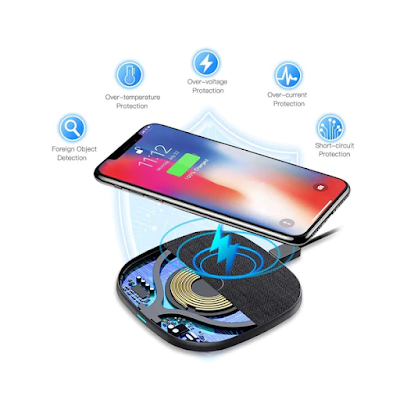
The UNIPAD 100 Wireless Charging Pad is a great way to keep your device charging without having to constantly plug and unplug. The UNIPAD 100 is a Qi wireless charging pad that is designed to charge any compatible device that supports wireless charging. It features a sleek design and a non-slip rubberized base that helps keep your device in place while charging. The UNIPAD 100 is equipped with an LED indicator light that displays the charging status of your device. It also features overcharge and short circuit protection to ensure your device is safe at all times. The UNIPAD 100 is compatible with most major brands and comes with a 1-year warranty.
UNIDOCK 300 3-in-1 Wireless Charging Mat
The UNIDOCK 300 3-in-1 Wireless Charging Mat is a convenient and stylish way to charge up to three devices simultaneously. It has three wireless charging coils built-in, so you can charge your phone, earbuds, and smartwatch all at once. The mat is Qi-certified with an output of 5W for each coil, and it also has a built-in LED indicator to show when a device is charging. It comes with a USB-C cable for easy connection to your computer or wall charger. The UNIDOCK 300 is designed with a modern, minimalistic look and is compatible with most major wireless charging devices.
UNISTAND-Magsafe Charging Stand
The UNISTAND Magsafe Charging Stand is a charger for Apple devices that uses Magsafe technology. It is designed to make charging your Apple devices easier and more convenient. The stand is adjustable and can be used with any Apple device that has a Magsafe connector. The stand has a strong and sturdy design, and it is made of high-quality materials. It also has an LED indicator that lets you know when your device is charging. With its sleek design and lightweight construction, the UNISTAND Magsafe Charging Stand is perfect for your desk or nightstand.
To use a Qi wireless charger, you simply place your phone on the charging pad. The charger will detect the presence of the device and begin charging it automatically. Most wireless chargers have LED lights that indicate when the device is charging and when it is fully charged.
One of the advantages of using a Qi wireless charger is that it eliminates the need for cables, which can be inconvenient and easily tangled. Additionally, it can help prolong the lifespan of your phone's charging port, as you won't need to plug and unplug your phone as often.
However, it's important to note that not all phones are compatible with Qi wireless charging, so it's important to check your phone's specifications before purchasing a wireless charger. Additionally, the charging speed may be slower than using a traditional cable, so you may need to leave your phone on the charger for a longer period of time to achieve a full charge.
Wireless charging and wired charging have been around for a while now. While wired charging is still the most common method of powering up your devices, the wireless charging market is becoming increasingly popular.
Wireless charging is a convenient and efficient way to charge your devices without the hassle of cords and plugs. Wireless chargers are typically small, lightweight, and easy to transport, making them ideal for travel. The biggest benefit of wireless charging is that it eliminates the need for an adapter or cable, which can be inconvenient and bulky. Wireless chargers are also great for use in public spaces, as they don’t require users to carry around a cable or adapter.
Wired charging, on the other hand, is the traditional method of powering up your devices. It requires a cable or adapter to be plugged into a power source, such as a wall outlet or computer. This method of charging is secure, reliable, and can be used to charge multiple devices at the same time. It is also the most common way of charging phones, tablets, and other devices.
However, wired charging can be inconvenient and bulky, as users must carry a cable or adapter with them at all times. Additionally, some devices require specific cables and adapters to charge, which can be a hassle for users. Furthermore, wired charging is not as energy efficient as wireless charging, as the power losses through the cable can be significant.
Overall, the biggest benefit of wireless charging is convenience. Wireless chargers are small, lightweight, and easy to transport, making them the ideal solution for people on the go. Additionally, wireless chargers don’t require a cable or adapter, which eliminates the hassle of carrying around extra cords and adapters. Finally, wireless chargers are more energy efficient than wired chargers, as they don’t suffer from power losses through the cable.
However, wireless charging is not without its drawbacks. Wireless chargers are typically more expensive than wired chargers, and some devices are not compatible with wireless chargers. Additionally, wireless chargers can be slow, as they take longer to fully charge a device than wired chargers.
Overall, both wireless and wired chargers have their advantages and disadvantages. Wired chargers are more reliable and secure, while wireless chargers are more convenient and energy efficient. Ultimately, the choice between the two depends on the user’s needs and preferences.
Although
charging our gadgets is a necessary part of daily life, we could all do without
the ugly charging wires, the stress of looking for a charger, and the
irritation of forgetting to plug in our phones.
All
of this may be resolved with wireless charging and a wireless charging pad. The
newest smart devices do not require a little cable to be plugged in as charging
technology advances. Both Android phones and iPhones can absorb a charge by
just resting them on a particular mat. You might even be able to charge a
device wirelessly in the future merely by being next to a charger, eliminating
the need to remove the item from your pocket. But because that day hasn't come
yet, let's assess the benefits and drawbacks of current wireless charging for
iPhones and Android smartphones to assist you in determining whether it's the
best option for you.
How does wireless charging work?
A
specialized wireless charging pad uses electromagnetic induction, also known as
"inductive coupling," to transfer energy to your device instead of
plugging it into a charging cable. All phones that allow wireless charging can
still be charged with a cable; it does not take the place of cable charging.
What phones have wireless charging?
Many
Android smartphones and iPhone models from the 8th generation and beyond
feature native wireless charging. A wireless charging adaptor can be used to
add wireless charging to any iPhone, from the 5s to the 7 Plus, and the
majority of Apple's upcoming mobile devices are expected to support it. The Samsung
Galaxy Range and unigen wireless charger are two examples of Android phones
that feature native wireless charging.
Pros of wireless charging
Both
wireless charging and using a wireless phone charger have advantages. Here are
some benefits of wireless charging for you.
With wireless charging, you just need one cable plugged into the charging mat; additional wires are no longer necessary for different devices. Additionally, every gadget is compatible with the global standard for wireless charging known as Qi. As a result, wireless charging for iPhones and Android devices is the same. You may charge all of your devices with the same charging mat.
Convenience: Charging begins as soon as your phone is placed face-up on the mat. You only have to do that!
Charge anywhere: Hotels, restaurants, and coffee shops have already begun to install wireless charging mats. Additionally, they are safer than using an unidentified charging cable to connect your smartphone.
Free of clutter charging: There are no cables when you use wireless charging. You will eliminate the cables from your desk, nightstand, and vehicle. Some furniture manufacturers even incorporate wireless charging capabilities into their products, doing away with the requirement for a charging mat on your table or countertop.
Auto-off: When the device is fully charged, the wireless charger turns off, saving energy, ensuring a safer charge, and reducing the risk of your battery overheating.
Less cable wear: You may still charge your phone via wires as necessary, but by using them less frequently, frayed cables are a thing of the past.
Cons of wireless charging
Going
wifi might seem like a no-brainer. However, there are a few drawbacks to
wireless charging.
It is slow In comparison to a cable, wireless charging often requires 30-80% more time to fully charge your device. Remember that the charging time for your smartphone can vary depending on how you position it on the mat. Even in the best scenario, 20% of the power flowing through your gadget will be lost, which is not excellent for energy conservation.
You Can't Use Your Phone: Because your device must stay on the mat while it charges, you are unable to use it as you would if it were plugged into a charging cable.
It costs more money: Particularly when compared to cords, wireless chargers are an expensive new technology. They can cost anywhere between $40 and $100, depending on size.
Conclusion
Wireless
charging is likely to become the norm as smart devices develop further. To
determine if you're prepared for this new technology before that time comes,
weigh the advantages and disadvantages and keep an eye on the newest phone
accessories.
The MagEZ Slider combines the greatest aspects of wireless charging into a stylish product that will get you ready for the future if you're looking for a magnetic wireless charger for many devices.
An upright magnetic phone stand for your home or workplace is the MagEZ Slider. Snap your MagSafe-enabled phone on the stand so it can charge, whether it's an iPhone with built-in MagSafe or another phone with a MagSafe cover. Simply slip your phone out of the magnetic power bank when you need to charge it while you're on the go, and you can travel anywhere with a portable battery. Even your Apple Watch and wireless earbuds may be charged with it.
The MagEZ Mount Qi Desktop is the best choice if all you need is a straightforward magnetic phone mount. Just secure your phone for quick and reliable wireless charging. You may change the angle of your device for a comfortable view thanks to the 360° ball joint.
The MagEZ Mount Qi is a must-have if you want to charge your phone while driving as well. While you're driving, the magnetic wireless vehicle charger keeps your mobile device in place. At the same time, it is charging. So, with a fully charged smartphone in hand, just grab and go when you get out of the car. The best option for your iPhone 12, iPhone 13, or S22 with the MagEZ Case 2 is the MagEZ Car Mount Pro, which is MagSafe compatible.
Make Your Next iPhone Charger A Magnetic Wireless Charger
No matter when the portless iPhone is released, it is obvious that wired charging is nearing its end. Get ahead of the curve by purchasing magnetic wireless chargers to use at home, in the office, and the car. These chargers will give you a solution that is both fashionable and useful while also being future-proof.
Magnetic Wireless Chargers are More Convenient
Magnetic characteristics for wireless chargers have become more prevalent in recent years as wireless has become the standard.
Regular wireless chargers, according to some, are not worthwhile investments because you can't use your phone while they're charging. A brief magnetic field must be created between the wireless charger and your phone for wireless charging to take place. Moving your phone breaks the field, which stops the charging.
But with a magnetic wireless charger, you can mount power banks and charging cases to the back of your device, giving it steady juice all day long without having to worry about where you put the phone on the charger.
The iPhone 11 box is now available! You couldn't wait to open the package. The new phone was well-made, the cord looked to work, and the charger was once again 5W! Who required another brick of 5W? You muttered inwardly.
When you get the iPhone 12 this year, it won't happen again. But what's this? absolutely no power adapters!
It's time to shift your attention to magnetic wireless chargers if you're going to buy a wireless charger for your iPhone, whether it's new or old.
Why Choose A Wireless Charger for Your iPhone?
Apple is Going Wireless.
Apple removed the headphone jack from the iPhone in 2016, which generated a lot of debate.
Wireless charging became a regular feature of the iPhone in 2017 and was included in the iPhone 8 and iPhone X models.
The official release of the iPhone 12 series was in 2020. The rumor that the iPhone 12 didn't come with a power adapter is accurate. In addition, AirPower also seems to be back after being introduced and ultimately discontinued three years ago.
In addition, it appears that the first iPhone without any connectors will be released in 2021. This notion is supported by several speculations, including Apple's alleged removal of charging cables from the yet-to-be-announced iPhone 12 series and its emphasis on wireless features for all products. Although it's too soon to say, it's not yet too early to be excited.
Wireless Charging Offers Many Benefits.
It could be difficult for individuals who don't now utilize wireless charging to comprehend why tech companies are so keen to phase out wired charging.
We go through some of the advantages of switching to wireless charging in the paragraphs below.
First, wireless chargers are available everywhere. Almost all other wirelessly charging gadgets, including Apple and Android devices, can use the same charger, except the Apple Watch (which uses proprietary charging). Because of this inclusivity, establishments like dining establishments, theaters, airports, and workplaces can incorporate built-in wireless chargers into their tables, workstations, and armrests without excluding any particular smartphone users.
Second, using wireless charging preserves the life of your smartphone. Your gadget won't sustain as much harm if the connector is never frequently plugged in or out. Not to mention that wireless charging charges your phone more slowly, which is better for your battery.
Last but not least, wireless charging supports a simple, basic lifestyle. Similar to an overgrown garden, cables produce clutter that can be difficult to control. They grow like vines from the back of our televisions like ivy covers our workstations, and like weeds take over our cars. By switching to wireless charging, we can create a future that is more organized and clean.
The only wireless charging standard currently used by the majority of significant phone makers is Qi. The word for qi is "chee."
Although Qi is not the only wireless charging technology, it is the first one to get the backing of two of the biggest and most significant smartphone manufacturers: Samsung and Apple.
What Is Wireless Charging?
Without using a charging cable, wireless charging enables you to power devices like smartphones. A magnetic field can be used to carry energy through the air using the inductive charging theory. An oscillating magnetic field is produced between a transmitter (in this case, a charging pad plugged into a power outlet) and a receiver (a phone). Through a unique antenna, the receiver collects current that can be stored in the device's battery. Although fundamental technology has been present for more than a century, the introduction of mobile technology has increased awareness of it.
How Does Qi Wireless Charging Work?
Although wireless charging technology's inner workings are extremely complicated, the fundamental idea is straightforward. You need two parts called induction coils to wirelessly charge something. Wireless charging stations, compatible phones, and these coils are copper wire loops.
The two coils can momentarily take on the function of a transformer when a suitable device is put on a charging station. This means that when the charging station produces an electromagnetic field, it also induces an electrical current in the device's coil. Similar to a cable charger, the battery is charged by the passage of that current into it.
There's a strong chance you've previously utilized wireless charging if you own an electric toothbrush. When placed on a Qi wireless charging pad, some rechargeable toothbrushes will start charging.
What Is the Qi Standard?
There are two rival forms of wireless charging systems, albeit they all operate on the same principles. Magnetic inductive and magnetic resonance charging are the names given to them.
The original version of the Qi standard, which was released in 2010, defined an inductive technique for wirelessly charging gadgets. It spelled out the manner that devices would connect with charging stations to ensure safe and effective charging in addition to defining three different power ranges for wireless chargers.
Why Do Phone Manufacturers Favor Qi?
There are several reasons why phone manufacturers chose Qi over competing protocols. The first, and most significant, is that Qi had a significant head start. Since the Qi standard was first released in 2010, chip designers could create chips that serve as a shortcut for charging stations and phone manufacturers.
Without spending a lot of money on R&D, phone manufacturers were able to deploy wireless charging in an affordable way using these off-the-shelf components. Additionally more energy-efficient than resonant charging, Qi's inductive charging technology often uses lesser components. As a result, inductive Qi chargers might be smaller than similar products.
Many Android manufacturers, including Nokia, LG, and HTC 2012, embraced the technology early due to the accessibility of off-the-shelf CPUs and small components. Others eventually joined the suit, and within the next few years, almost all significant Android phone manufacturers will support Qi.
2014 saw the addition of resonance charging standards to the Qi 1.2 standard. As a result, phone manufacturers worried about backward compatibility gravitated toward Qi, which became the only standard containing specs for both inductive and resonant charging.
Apple and Qi Wireless Charging
While some Android manufacturers joined the Wireless Power Consortium (WPC), the group that created the Qi standard, as early as 2012, Apple didn't join until the iPhone 8 was released in 2017.
Apple modified a Qi-based system for the Apple Watch considerably sooner than it did when it joined the WPC. The Apple Watch is unable to use Qi charging stations due to modifications made to that implementation.
Apple opted to use the Qi standard instead of the modified version beginning with the iPhone 8 and iPhone X. This choice made it possible for customers of Apple and Android devices to utilize the same charging infrastructure.
How to Use Qi Wireless Charging
Inductive charging pads have a significant drawback in that they can be picky about the location and alignment of a receiver device. While resonance charging has much more flexibility, Qi-enabled devices need to be positioned very precisely.
Some manufacturers of charging stations get around this by putting several charging coils in a single station. Your phone must still be properly aligned with one of them for it to charge, though. Guide marks that indicate how and where to place your phone on the charging station are typically added to address this.
Aside from that, wireless charging a phone with Qi is easy. Your phone is placed on top of the charging station after it has been plugged into the wall or an accessory outlet in your car. The phone will continue to charge as long as it is in its position.
Where Can a Phone Be Charged With Qi?
You can purchase Qi chargers integrated into furniture in addition to desktop charging mats and cradles made specifically for automobiles. There is even an app that can direct you to a public charging station in your neighborhood.
If your phone doesn't already have wireless charging built-in, you can add it with a case. As an alternative, you can even purchase a slim charging device that slides in between your phone and the case you already have.




.png)


.png)


